

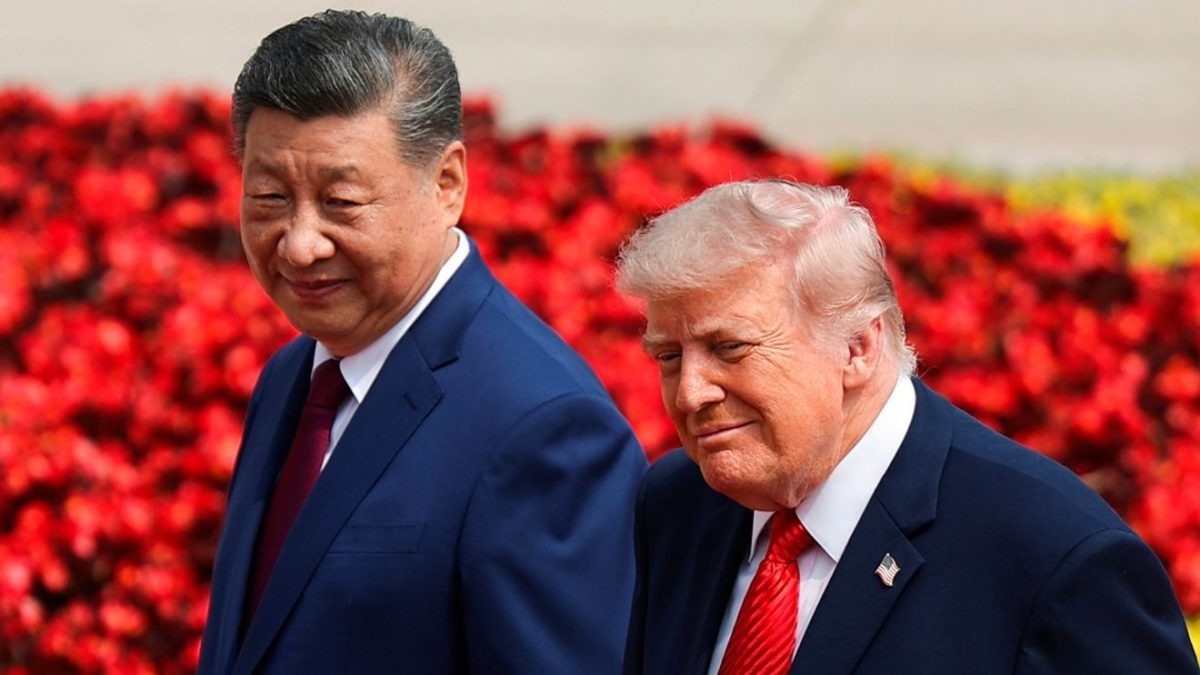
BEIJING (TNND) — China’s Xi Jinping warned President Donald Trump on Thursday of potential “clashes and conflicts” over Taiwan if U.S. arms sales to the island are not handled properly.
The warning came as the two leaders met for high-stakes talks at the start of a multi-day summit in Beijing. Despite the sharp message on Taiwan, both men struck a warm tone during a welcome ceremony at the Great Hall of the People.
Xi opened by referencing growing global instability, including the war involving Iran, and said the world had “arrived at a new crossroads.”
“We should be partners rather than opponents, achieve success for one another, prosper together, and forge a correct way for major countries of the new era to get along with each other,” he said.
Trump responded positively, hailing their “fantastic relationship” and saying he had “such respect” for Xi and China, calling the Chinese president a “great leader.”
PHOTOS: China’s Xi welcomes Trump in grand spectacle featuring military, waving children
While the full agenda for the state visit has not been publicly detailed, officials indicated the leaders were expected to discuss a range of issues, including the Iran war, trade, technology, and Taiwan.
Chinese Foreign Ministry spokesperson Mao Ning said on X that Xi told Trump “the Taiwan question is the most important issue in China-U.S. relations.”
“If it is handled properly, the bilateral relationship will enjoy overall stability. Otherwise, the two countries will have clashes and even conflicts, putting the entire relationship in great jeopardy,” she wrote.
The Trump administration has approved an $11 billion arms package for Taiwan, but has not yet begun delivering it.
Taiwan said after the Xi-Trump meeting that it was grateful for Washington’s “long-term support.”
“The government views all actions that contribute to regional stability and the management of potential risks from authoritarian expansion positively,” Michelle Lee, a spokesperson for Taiwan’s premier, told reporters. She added that the U.S. “has also repeatedly reiterated its firm and clear position of support for Taiwan.”
The White House said the two sides also discussed ways to enhance economic cooperation, including expanding market access for American businesses in China and increasing Chinese investment in the United States.
The leaders also agreed that the Strait of Hormuz — a vital shipping corridor threatened by Iran amid the war — must remain open to ensure the free flow of energy, and that Tehran can never be allowed to obtain a nuclear weapon.
China remains Iran’s largest trading partner, purchasing roughly 90% of its exported oil and generating billions of dollars annually for Tehran, according to the U.S.-China Economic and Security Review Commission.
“President Xi also made clear China’s opposition to the militarization of the strait and any effort to charge a toll for its use, and he expressed interest in purchasing more American oil to reduce China’s dependence on the strait in the future,” the White House said in its readout of the meeting.
After their talks, Xi took Trump on a tour of the Temple of Heaven before hosting a state banquet. During an evening toast, Xi said he and Trump had kept U.S.-China relations “generally stable” despite global turbulence.
“Achieving the great rejuvenation of the Chinese nation and making America great again can go hand in hand,” Xi said, referring to Trump’s political movement. “We can help each other succeed and advance the well-being of the whole world.”
In his own toast, Trump again called Xi “my friend” and described the visit as “a great honor” marked by a “fantastic” day. He said the leaders had discussed matters that were “all good for the United States and China.”
Trump also announced that Xi would make a reciprocal visit to the White House on Sept. 24, a date that had not previously been announced.
The White House has insisted Trump would not make the trip without pursuing concrete results, fueling expectations of possible trade-related announcements.
Those could include a Chinese commitment to purchase more U.S. soybeans, beef, and aircraft. Trump administration officials also hope to establish a U.S.-China Board of Trade aimed at resolving commercial disputes between the two countries.
The U.S. and China reached a trade truce last year that eased threats of steep tariffs on both sides. The White House said discussions have continued and that both governments are interested in extending the agreement.
The leaders also discussed further efforts to stem the flow of fentanyl precursor chemicals into the United States, as well as increasing Chinese purchases of American agricultural products, according to the White House.
The discussions highlighted both the potential for cooperation and the deep tensions that continue to shape the U.S.-China relationship.
_____
Editor’s note: The Associated Press contributed to this article.