

by The National News Desk
Thu, May 14, 2026 at 9:07 AM
Updated Thu, May 14, 2026 at 9:16 AM

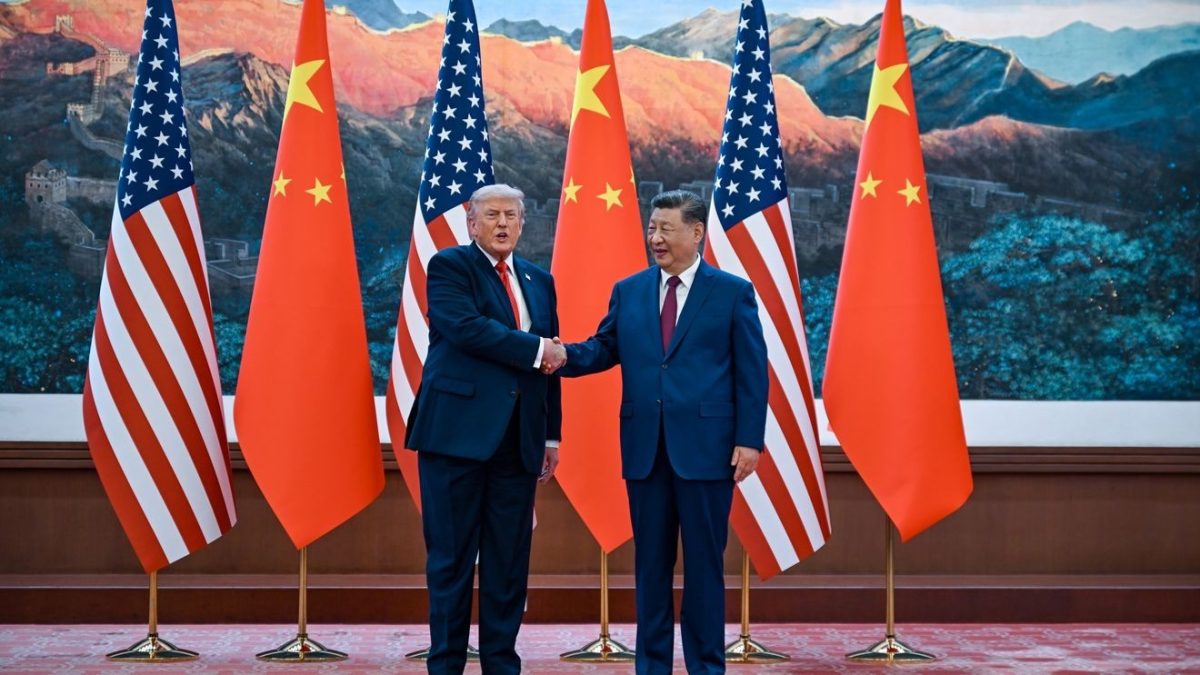
BEIJING, CHINA – MAY 14: U.S. President Donald Trump (L) and Chinese President Xi Jinping participate in a welcoming ceremony at the Great Hall of the People on May 14, 2026 in Beijing, China. The trip by Trump is focused on trade, regional security, and strengthening bilateral ties between the world’s two largest economies. (Photo by Kenny Holston-Pool/Getty Images)
As President Donald Trump meets with Chinese President Xi Jinping for high-stakes talks, concerns over religious freedom in China are drawing renewed attention. The meeting comes as reports continue to emerge about the Chinese government’s treatment of religious groups, including Christians, with allegations of arrests, detentions, and restrictions on worship.
Former Ambassador for International Religious Freedom and former U.S. Senator Sam Brownback says the issue reflects a broader effort by China’s leadership to maintain control.
“They see people of faith as a potential challenge to their authority,” Brownback said. “The concern is that independent belief systems could become a foundation for resistance over time.”
Brownback pointed to what he described as a growing crackdown not only on Christians, but also on other religious groups, including Buddhists and Muslims, saying the approach is part of a wider strategy by the Chinese Communist Party to consolidate power.
At the same time, he noted that religious belief — particularly Christianity — continues to grow in China.
“China has one of the fastest-growing Christian populations in the world,” Brownback said, adding that this growth may be contributing to tensions between religious communities and the government.
Also joining the discussion was Grace Jin Drexel, whose father, Pastor Ezra Jin, remains detained in China.
According to Drexel, her father has been imprisoned since October 2025, along with multiple colleagues, after leading Zion Church — a large, independent congregation not affiliated with the Chinese government.
She says the charges against him involve the “illegal use of information online,” related to church activities including sermons, Bible readings, and worship services.
“Worshiping online, reading the Bible, sharing sermons — these are the activities they’re being accused of,” she said. “And it raises questions about why those actions are considered illegal.”
Drexel explained that her father converted to Christianity as a student in China following the 1989 Tiananmen Square protests, a period she described as a turning point in his life.
“He was searching for meaning after that experience,” she said. “And he found it in his faith.”
She added that her father later returned to China, despite risks, to continue leading his congregation after members asked him to come back.
“He knew the risks,” she said. “But he felt called to return.”
Both guests pointed to a broader trend of increasing religious interest in China, even as restrictions tighten.
Drexel said many people in China are searching for meaning beyond economic success.
“There’s a sense that material success alone doesn’t answer deeper questions,” she said. “And many people are looking for something more.”
Brownback echoed that view, suggesting that spiritual curiosity remains strong despite political pressures.
“There’s an inherent search for meaning,” he said. “And that’s something systems built purely on control or economics often struggle to address.”
Drexel said she was encouraged to hear that President Trump may raise her father’s case during discussions with President Xi.
“I was surprised and hopeful when I heard that,” she said. “We just want him released and able to come home.”
She acknowledged that the process could take time but expressed hope that diplomatic conversations could make a difference.